


Finding the right rental property in Malaysia often involves more than just the monthly rent. There are legal and administrative costs that both tenants and landlords should be aware of. Among them, stamp duty and administration fees play a key role in making your tenancy agreement valid and legally binding.
This 2026 guide breaks down the tenancy agreement stamp duty table, including how stamp duty is calculated, the latest exemption updates, the convenience of e-stamping, and common mistakes to avoid. Whether you’re renting out your property or moving into a new home, here’s how you can stay compliant and budget smartly for your tenancy agreement in Malaysia.
| Table of Contents 1. What Is Stamp Duty All About? 2. Latest Stamp Duty Updates and Exemptions in 2026 3. How To Calculate Stamp Duty in Malaysia 4. Digital Tenancy Agreements and e-Stamping in Malaysia 5. How Much Is the Administration Fee for Tenancy Agreements? 6. Common Mistakes to Avoid When Paying Stamp Duty or Administration Fees 7. Tips to Save on Stamp Duty and Administration Fees |
What Is Stamp Duty All About?
Stamp duty and administration fees are two essential costs involved in finalising a tenancy agreement in Malaysia. Stamp duty is a government-imposed tax collected by the Inland Revenue Board of Malaysia (LHDN) to make the tenancy agreement legally valid and enforceable in court.
Administration fees, on the other hand, are service charges collected by the landlord or property agency to cover the cost of preparing, handling, and processing the tenancy paperwork. Together, these charges ensure that both parties, tenant and landlord, are protected by a properly documented and legally recognised rental contract.
In 2026, the Inland Revenue Board of Malaysia (LHDN) will continue to oversee stamp duty requirements for tenancy agreements, with updated rates and policies designed to clarify compliance obligations for both landlords and tenants.
Understand Landlord Rights
Learn what every tenant and landlord should know
Latest Stamp Duty Updates and Exemptions in 2026
The tenancy agreement stamp duty table helps tenants and landlords estimate the payable duty based on the rental amount and tenancy term. Stamp duty on tenancy agreements is calculated based on the annual rental amount, charged at the following rates per RM250 or part thereof of the yearly rent:
| Tenancy Duration | Stamp Duty Rate (per RM250 of Annual Rental) |
| One year or less | RM1 |
| More than one year up to three years | RM3 |
| More than three years up to five years | RM5 |
| Exceeding five years (or indefinite) | RM7 |
Exemption Threshold
As of January 1, 2026, the previous exemption of the first RM2,400 of annual rental income from stamp duty has been removed. Consequently, the full yearly rental amount is now subject to stamp duty without any exemption.
Additional Copies of Tenancy Agreements
For each additional copy of the tenancy agreement beyond the first, a flat stamping fee of RM10 is applicable.
Other Important Notes
- Stamp duty must be paid and the agreement stamped within 30 days from the date of signing.
- Penalties for late stamping start at RM50 or 10% of the duty within three months, and RM100 or 20% after three months, whichever is higher.
- LHDN provides electronic stamping (e-Stamping) services through its online portal, allowing landlords and tenants to conveniently process stamp duties digitally.
- Both digitally stamped and physically stamped tenancy agreements are legally valid and enforceable when stamped adequately in accordance with LHDN regulations.
Understanding these updated rules will help landlords and tenants ensure compliance and avoid penalties related to stamp duty on tenancy agreements in Malaysia in 2026.
How To Calculate Stamp Duty In Malaysia?
Calculating stamp duty for a tenancy agreement in Malaysia is straightforward once you know your annual rental and the applicable stamp duty rate. The process also takes into account the RM2,400 exemption for annual rental income.
Formula to Calculate Stamp Duty:
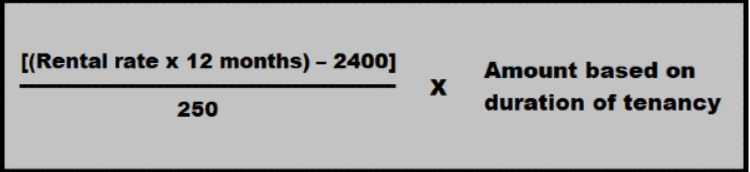
Example Calculation
Assume a unit is rented at RM1,200 per month.
Step 1: Calculate Annual Rental
1,200 × 12 = 14,4001,200 \ times 12 = 14,4001,200 × 12 = 14,400
Step 2: Deduct Stamp Duty Exemption (RM2,400)
14,400 − 2,400 = 12,000 (Taxable Rental) 14,400 – 2,400 = 12,000 \text{ (Taxable Rental)}14,400 − 2,400 = 12,000 (Taxable Rental)
Step 3: Apply Stamp Duty Rate Based on Tenancy Duration
One year or less
RM1 per RM250
12,000 ÷ 250 × 1
RM48
More than one year up to three years
RM3 per RM250
12,000 ÷ 250 × 3
RM144
More than three years up to five years
RM5 per RM250
12,000 ÷ 250 × 5
RM240
Exceeding five years
RM7 per RM250
12,000 ÷ 250 × 7
RM336
Step 4: Additional Copy (if any)
Add RM10 per extra copy of the tenancy agreement.
Add RM10 per extra copy of the tenancy agreement.
For example, for one year or less with an additional copy:
48 + 10= RM5848 + 10 = RM5848 + 10 = RM58
Note: Round the taxable rental up to the nearest RM250 if it’s not a multiple of 250 before calculating.
Check Tenancy Agreement
Know the 3 key things before renting in Malaysia
Digital Tenancy Agreements and e-Stamping in Malaysia
In 2026, tenancy agreements in Malaysia are increasingly transitioning to digital formats, making the rental process faster, more convenient, and more environmentally friendly. A digital tenancy agreement allows landlords and tenants to create, review, and sign contracts online, reducing paperwork and streamlining the rental process.
To make these agreements legally valid, the Inland Revenue Board of Malaysia (LHDN) offers e-stamping, a secure online method for paying and registering stamp duty. Through LHDN’s e-stamping portal, tenants and landlords can:
- Submit tenancy agreements electronically for stamping.
- Pay stamp duty online without visiting the LHDN office.
- Receive instant confirmation and a legally recognised e-stamp certificate.
Benefits of e-Stamping:
- Convenience: No need for physical documents or office visits.
- Speed: Instant payment and registration reduce delays.
- Security: Digital records are safely stored and easily verifiable.
- Compliance: Ensures the tenancy agreement is legally enforceable in court.
For tenants and landlords, adopting digital tenancy agreements and e-stamping is the modern way to stay compliant while saving time and effort.
How Much Is The Administration Fee For Tenancy Agreements?
The administration fee for a tenancy agreement in Malaysia is a one‑time charge, typically paid by the tenant and calculated based on the monthly rental amount.
Here is the general guideline:
| Monthly Rental | Administration Fee |
| Less than RM 1,000 | RM 100 |
| RM 1,001 to RM 1,999 | RM 150 |
| RM 2,001 to RM 3,000 | RM 200 |
| RM 3,001 to RM 4,000 | RM 250 |
| Over RM 4,000 | RM 300 |
Common Mistakes to Avoid When Paying Stamp Duty or Administration Fees
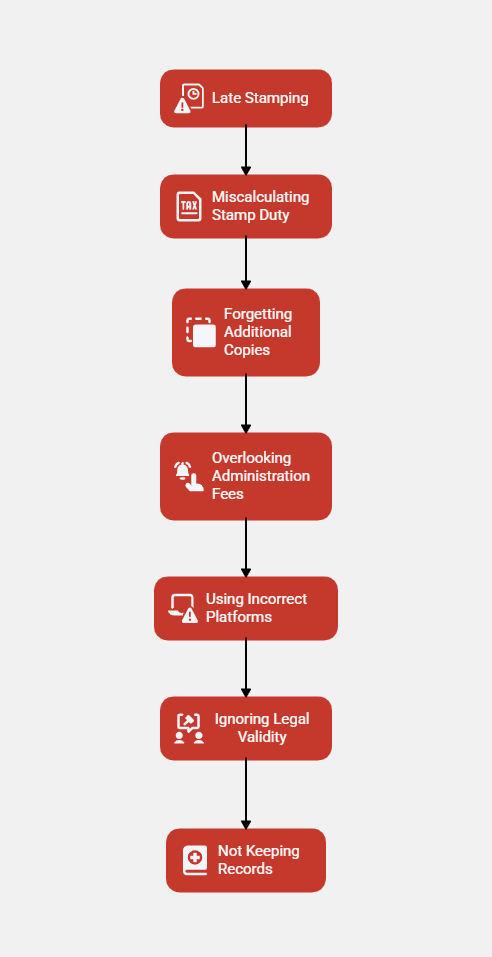
When handling tenancy agreements in Malaysia, tenants and landlords often make errors that can result in unnecessary penalties, legal complications, or additional costs. Being aware of these common mistakes helps ensure the process is smooth and compliant.
1. Late Stamping of the Tenancy Agreement
One of the most common mistakes is failing to stamp the tenancy agreement within the stipulated period. In Malaysia, the instrument must be stamped:
One of the most common mistakes is failing to stamp the tenancy agreement within the stipulated period. In Malaysia, the instrument must be stamped:
- Within 30 days from the date it is executed in Malaysia, or
- Within 30 days after it is received in Malaysia if executed abroad.
Failure to do so results in penalties:
- Within three months: RM50 or 10% of the deficient duty, whichever is higher.
- After three months: RM100 or 20% of the deficient duty, whichever is higher.
2. Miscalculating Stamp Duty
Many tenants and landlords make errors when calculating stamp duty. Common mistakes include:
Many tenants and landlords make errors when calculating stamp duty. Common mistakes include:
- Forgetting to deduct the RM2,400 exemption from annual rental.
- Not rounding up taxable rental to the nearest RM250.
- Using outdated rates or not considering the tenancy duration correctly.
These mistakes can lead to either overpayment or penalties for underpayment.
3. Forgetting Additional Copies
If multiple copies of the tenancy agreement need to be stamped (e.g., one for the landlord, one for the tenant), it is easy to forget the RM10 fee per extra copy. Neglecting this step may cause legal complications if only one copy is considered valid.
If multiple copies of the tenancy agreement need to be stamped (e.g., one for the landlord, one for the tenant), it is easy to forget the RM10 fee per extra copy. Neglecting this step may cause legal complications if only one copy is considered valid.
4. Overlooking Administration Fees
Some tenants assume that stamp duty is the only cost and forget about administration fees. Landlords or real estate agencies typically charge this fee based on the monthly rental, and ignoring it can result in disputes.
Some tenants assume that stamp duty is the only cost and forget about administration fees. Landlords or real estate agencies typically charge this fee based on the monthly rental, and ignoring it can result in disputes.
Typical administration fee guideline:
- Less than RM1,000: RM100
- RM1,001 to RM1,999: RM150
- RM2,001 to RM3,000: RM200
- RM3,001 to RM4,000: RM250
- Over RM4,000: RM300
5. Using Incorrect or Unverified Platforms for e-Stamping
With the rise of digital tenancy agreements and e-stamping, some tenants and landlords may attempt to use unofficial portals. Always use the LHDN official e-stamping portal to avoid fraud and ensure legal recognition.
With the rise of digital tenancy agreements and e-stamping, some tenants and landlords may attempt to use unofficial portals. Always use the LHDN official e-stamping portal to avoid fraud and ensure legal recognition.
6. Ignoring Legal Validity
Stamp duty and administration fees are not just formalities; they make your tenancy agreement legally binding. Failing to comply with these requirements can make it difficult to enforce the agreement in court in case of disputes.
Stamp duty and administration fees are not just formalities; they make your tenancy agreement legally binding. Failing to comply with these requirements can make it difficult to enforce the agreement in court in case of disputes.
7. Not Keeping Records
A final common mistake is not keeping copies of stamped agreements and receipts. Both tenants and landlords should store these securely as proof of payment and compliance.
A final common mistake is not keeping copies of stamped agreements and receipts. Both tenants and landlords should store these securely as proof of payment and compliance.
Pro Tip: Double-check your calculations, pay on time, and always keep records of all stamped documents and administration payments. This prevents unnecessary fines and ensures a smooth rental experience.
Tips to Save on Stamp Duty and Administration Fees
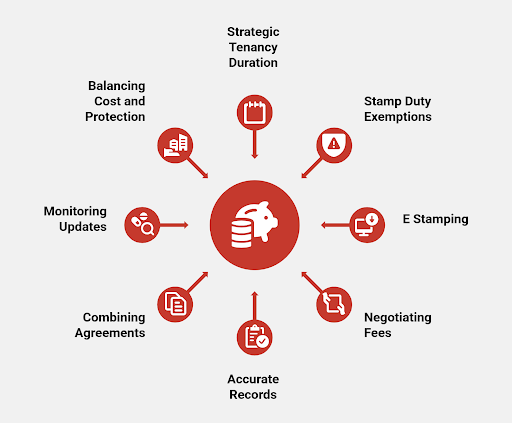
Paying stamp duty and administration fees is an unavoidable part of finalising a tenancy agreement in Malaysia. However, with careful planning and informed decisions, both tenants and landlords can reduce costs and avoid unnecessary penalties. Here are practical tips that can help save money while ensuring compliance with legal requirements.
1. Plan Your Tenancy Duration Strategically
Stamp duty is calculated based on the tenancy duration and the annual rental. Short-term agreements generally incur lower stamp duty compared to longer tenancies, making it cheaper for tenants renting for a year or less. Landlords who prefer longer tenancies should factor in the higher stamp duty and plan accordingly.
Example:
If a unit rents for RM1,200 per month:
If a unit rents for RM1,200 per month:
- One-year tenancy: RM48 stamp duty
- Three-year tenancy: RM144 stamp duty
- Five-year tenancy: RM240 stamp duty
By understanding these rates, tenants and landlords can determine a tenancy period that strikes a balance between affordability and stability.
2. Stamp Duty Exemptions
Stamp duty on tenancy agreements in Malaysia for 2026 is calculated based on the full annual rental amount without any exemption. To calculate, multiply the monthly rent by 12 to get the annual rent, then divide the annual rent by RM250 and round up to the nearest whole number. Multiply this number by the stamp duty rate applicable to the tenancy duration, and add RM10 for the tenant’s copy of the agreement.
For example, if the monthly rent is RM1,800 with a tenancy period of three years:
- Annual rent = RM1,800 x 12 = RM21,600
- Divide by RM250 and round up: RM21,600 ÷ 250 = 86.4 → rounded up to 87
- Stamp duty rate for three-year tenancy = RM3 per RM250
- Stamp duty = 87 x RM3 = RM261
- Add RM10 for tenant’s copy = RM271 total stamp duty payable
3. Use Digital e-Stamping to Avoid Penalties and Save Time
The LHDN e-stamping portal allows users to submit tenancy agreements online, calculate stamp duty automatically, and receive instant confirmation. Using e-stamping:
- Eliminates travel and administrative delays.
- Ensures timely payment, avoiding late fines.
- Reduces the risk of errors in calculation, which can lead to overpayment.
By using digital methods, tenants and landlords can save both time and money while staying compliant.
4. Consider Negotiating Administration Fees
Administration fees are usually a one-time payment charged by landlords or agencies to cover the processing of tenancy agreements. Before signing the agreement, tenants can negotiate with the landlord or agency, especially if renting multiple units or signing longer-term agreements. For landlords, keeping fees reasonable can make properties more attractive to potential tenants.
5. Keep Accurate Records to Avoid Repeated Payments
A simple but often overlooked tip is to store copies of stamped agreements and receipts. Losing records may require additional stamping or verification, which incurs extra costs. Digital copies, in particular, should be backed up securely.
6. Combine Tenancy Agreements Where Possible
For landlords with multiple units rented to the same tenant, it may be possible to combine agreements or structure payments smartly. This could reduce the number of additional copies needing stamping, saving RM10 per copy while remaining legally valid.
7. Monitor Updates from LHDN Regularly
Stamp duty rates and exemptions may be updated periodically. Staying informed about policy changes can help tenants and landlords plan better, take advantage of new exemptions, and avoid overpaying.
8. Balance Between Cost and Legal Protection
While it might be tempting to minimise costs by skipping professional advice, paying attention to both stamp duty and administration fees ensures the tenancy agreement is legally enforceable. Proper documentation prevents disputes and potential losses, which could be far costlier than the fees themselves.
Saving on stamp duty and administration fees requires a combination of planning, awareness, and smart use of digital tools. Tenants can choose tenancy durations wisely, take advantage of exemptions, and pay fees promptly using e-stamping.
Landlords can offer reasonable administration fees, ensure accurate stamping, and provide digital copies to tenants. By following these tips, both parties can reduce costs, avoid penalties, and maintain a legally secure tenancy agreement in Malaysia.
For more insights on financial readiness, home loans, and property buying tips, visit the PropertyGuru Guides Section.
Still searching for your ideal home? Check out the exclusive sale listing on PropertyGuru Malaysia today!
Disclaimer: The information is provided for general information only. PropertyGuru International (Malaysia) Sdn Bhd makes no representations or warranties in relation to the information, including but not limited to any representation or warranty as to the fitness for any particular purpose of the information to the fullest extent permitted by law. While every effort has been made to ensure that the information provided in this article is accurate, reliable, and complete as of the time of writing, the information provided in this article should not be relied upon to make any financial, investment, real estate or legal decisions. Additionally, the information should not substitute advice from a trained professional who can take into account your personal facts and circumstances, and we accept no liability if you use the information to form decisions.